


You can understand why your relationship isn't working and still have no idea how to change it.
I think this is one of the most frustrating experiences couples face.
Couples often come to therapy distressed by arguments that repeat despite understanding why they happen. They can identify the pattern intellectually but struggle to create a more connected response in the moment.
You may spend hours talking about your relationship, perhaps even in therapy, identifying patterns, considering childhood experiences, and recognizing what triggers conflict.
Then a familiar interaction activates the nervous system and the old pattern returns. A partner says something, gives a certain look, or responds differently than hoped.
Suddenly, you are back in the same dreaded and repetitive cycle.
One person may become defensive while the other withdraws. One seeks connection while the other needs distance. At times, both partners become increasingly activated and the conflict escalates.
You both know what's happening, but neither of you seems able to stop it.
This is one reason I integrate somatic approaches and yoga therapy into couples work.
Understanding a pattern is important, but insight alone may not change it. Couples also need opportunities to practice a different experience.
Our Relationships Are More Than Conversations
We do not experience relationships only through thought. Emotions, physical sensations, nervous-system responses, and learned strategies for self-protection also shape how we relate to one another.
Consider what happens when you feel misunderstood by your partner. Your chest may tighten, your breathing may change, or you may feel an immediate urge to defend yourself. You might shut down, lose access to words, or want to leave the conversation.
These reactions are not always deliberate. They may reflect protective patterns developed long before the current relationship. Although these responses may once have been adaptive, they can create distance where connection is deeply wanted.
Why I Incorporate Somatic Therapy Into Couples Sessions
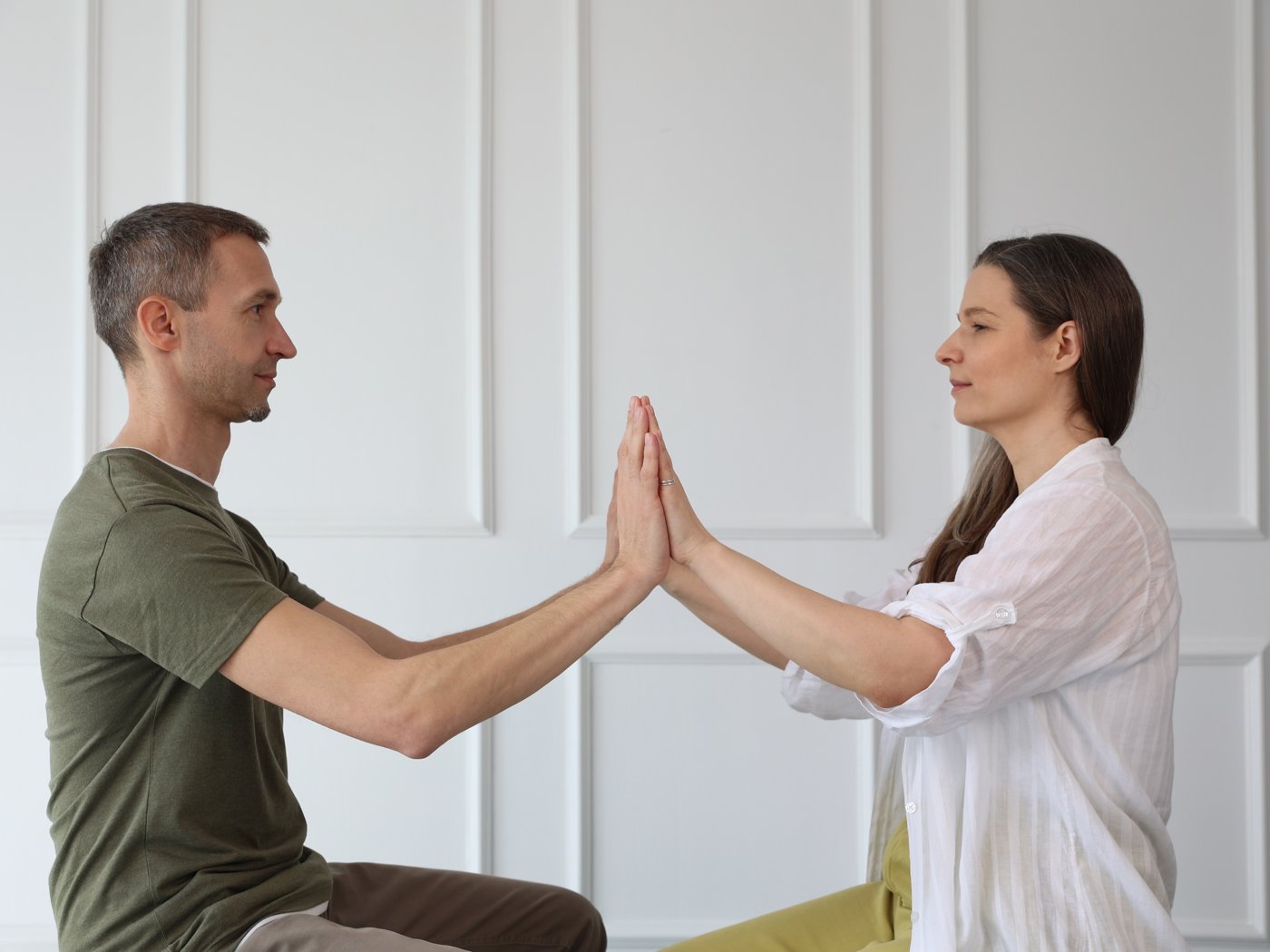
In couples sessions, I may integrate movement, restorative practices, guided imagery, and other experiential methods with traditional psychotherapy.
A session may begin with gentle movement or a restorative or grounding practice, not simply to promote relaxation, but to slow the pace and bring attention to internal experience. This can support regulation, awareness, and deeper therapeutic exploration.
I may invite partners to notice what occurs as they move closer, create distance, or respond to one another’s cues. Yoga therapy balls, the yoga wall, resistance bands or other props may also be used to explore boundaries, connection, movement, and emotional expression.
These exercises can make relational patterns more observable than conversation alone sometimes allows.
The process may raise useful questions: What happens when you want closeness and also feel a need to protect yourself? What is it like to communicate a need while anticipating rejection? Can you recognize when your body begins preparing for an argument before a word is spoken?
There is no correct movement or required emotional response. The work emphasizes curiosity, awareness, consent, and the possibility of responding differently.
What Happens to Anger in Our Relationships?
An important area in couples therapy is understanding how each partner experiences and expresses anger.
Many people learned early that anger was dangerous, unacceptable, or best suppressed; others learned it was the only reliable way to be heard. Anger and aggression, however, are not the same.
Anger is an emotion that may signal a crossed boundary, an unmet need, or something personally significant. Aggression refers to behavior used to express or act on that emotional energy.
Without skills for recognizing and regulating anger, a person may suppress it, direct it inward, become overwhelmed, or express it in ways that harm connection.
Somatic couples therapy can help partners notice how anger appears physically. This may involve movement, safe work with resistance, or attention to the impulses and sensations that accompany frustration.
The aim is to process the activation associated with anger without directing harmful behavior toward oneself or a partner. This work does not encourage aggression; it supports a safer, more regulated relationship with an emotion that may have been avoided, feared, or difficult to express.
Anger may also protect more vulnerable feelings, including fear, hurt, longing, or the need to know that one matters.
Learning to Experience Connection Differently
Another focus of this work is how each partner experiences connection. Connection involves more than words; it also includes how partners respond to each other’s cues and what occurs internally when either person feels seen, misunderstood, rejected, or supported.
Relational patterns do not live only in the words partners say. They also take shape through rapid, habitual nervous-system responses: a shift in tone, a tightening in the body, an urge to pursue, withdraw, defend, or disconnect. These reactions can occur before either partner has fully recognized what is happening. Learning to notice them creates more room for choice—and for a different experience of connection.
Movement, imagery, and experiential exercises can help couples observe these responses in real time. Partners may explore moving together, following or responding to cues, and recognizing when either person needs more space.
These experiences can build awareness of personal needs while supporting curiosity about a partner’s experience. That distinction matters because connection does not require partners to feel, respond, or think in the same way. It requires the capacity to remain aware of oneself while staying open to another person’s experience.
Moving Beyond Insight
Traditional talk therapy remains valuable. Understanding personal histories, attachment patterns, and relationship dynamics is an important part of treatment.
At the same time, people can understand their struggles in considerable depth and still feel stuck. They may know why they withdraw, become defensive, fear conflict, or seek reassurance, yet insight does not always produce a different response during a stressful interaction.
Somatic work can help bridge that gap.
Rather than discussing relationship patterns only in retrospect, partners can notice and explore them as they arise in session. They can practice recognizing an impulse without immediately acting on it, experience anger without becoming destructive, communicate a boundary while remaining connected, and tolerate closeness without losing contact with themselves.
Change is often gradual. It may begin with small, repeated experiences of responding differently.
You Don't Have to Be in Crisis to Work on Your Relationship
Many couples begin therapy after years of disconnection, but treatment can also be useful before the relationship reaches a crisis. You do not need to wait until resentment dominates or the future of the relationship feels uncertain.
You may be tired of repeating the same argument, avoiding honest conversations because conflict no longer seems worth it, or loving your partner while still feeling increasingly alone. You may also want to understand each other more fully and develop healthier ways to navigate stress and change.
Couples therapy can provide a structured setting to explore these concerns with curiosity, accountability, and less blame.
The goal is not to eliminate conflict. It is to help both partners express needs, maintain a sense of self, repair disconnection, and return to one another with greater flexibility.
Somatic Couples Therapy at Insight Family Therapy Group
As a Licensed Marriage and Family Therapist and Certified Yoga Therapist, I integrate traditional psychotherapy with somatic, relational, and experiential approaches. My clinical approach draws from attachment theory, Relational Gestalt Therapy, Somatic Experiencing®, Emotionally Focused Therapy, and Yoga Therapy.
Sessions are individualized and may include conversation, movement, restorative practices, guided imagery, and other body-centered interventions, based on each partner’s needs, preferences, and comfort.
If you are interested in a more experiential approach to couples therapy, I welcome you to reach out and learn more about working together.
Insight Family Therapy Group | Couples Therapy and Somatic Psychotherapy